
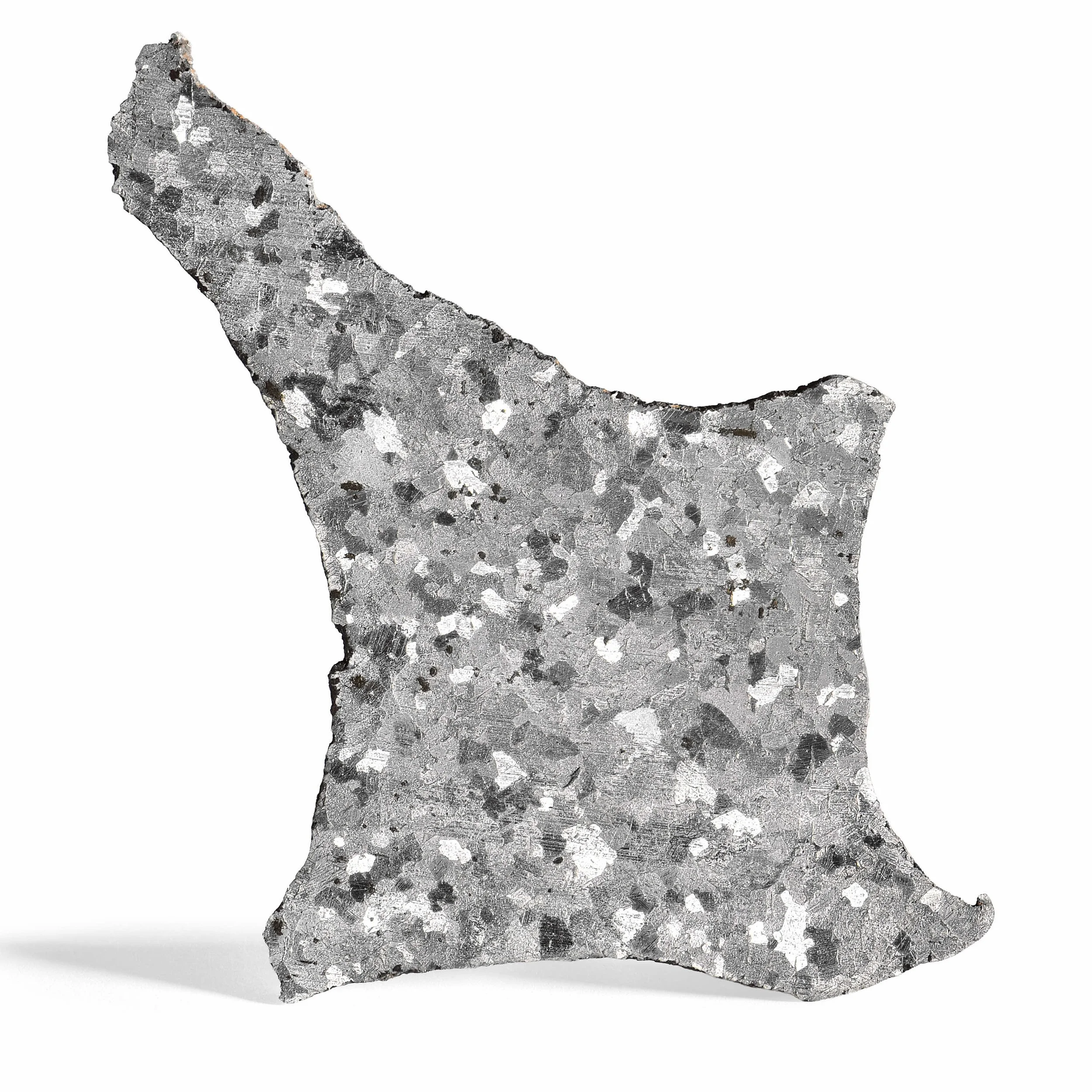
28. WILLAMETTE METEORITE — COMPLETE SLICE OF THE MOST FAMOUS METEORITE IN THE WORLD
IR-ungr
Clackamas County, Oregon
Found 1902 / 15.5 tons
(Similar to lot 10 but with greater surface area) How often is one able to obtain a specimen from a conspicuously missing section of a centerpiece exhibit in a world-renowned museum? The answer: never…apart from the exception described herein.
Apart from perhaps ALH 84001, the Willamette meteorite — the crown jewel of the American Museum of Natural History's Rose Center for Earth and Space in New York City — is the most famous meteorite in the world. It is also the largest American meteorite. As it was found on a forest surface, it is believed to have landed in Canada or Montana and was deposited in Oregon by a glacier and the Missoula Floods at the end of the last ice age.
Willamette was featured at the World’s Fair in the early 1900s and was acquired by Mrs. William Dodge, who donated it to the AMNH. The Willamette meteorite has been the centerpiece of the Museum’s Hayden Planetarium since it opened and an estimated 50 million people have seen or touched Willamette during its 120+ years of Museum exhibition. In 1997, a 13 kg crown section was cut from the main mass to reveal the meteorite’s unique internal structure. An anomaly was noticed by Darryl Pitt who advised UCLA cosmochemists John Wasson and Alan Rubin of the same — which resulted in Willamette’s ungrouped iron reclassification. Following a legal battle between the Museum and The Confederated Tribes of the Grand Ronde, Willamette will never again be cut. Featuring the maximum surface area for its weight, this is a select complete slice of the most famous meteorite in the world.
115 x 81 x 1mm (4.5 x 3.25 x 0.1 in.) and 25.1 grams
Provenance: American Museum of Natural History, New York City
Estimate: $3,500 – 4,500 * Reserve: $2,500